The AI Era is Really the Relationship Era: How AI Agents Unlock Human Connection
Jan 29, 2026
Why your competitive advantage in 2026 isn't AI agents—it's the relationships they make possible.
"How many jobs will AI eliminate?"
I've answered this question dozens of times over the past year. It's a revealing question that highlights the fundamental divide in how we perceive the future of work with AI.
There are two distinct camps emerging. The first sees AI as a replacement vehicle, every new capability is another step toward human obsolescence. I understand the fear. Change is unsettling, and AI's pace of advancement feels impossible to keep up with.
But I'm firmly in the second camp. We see AI agents as an evolution engine that will fundamentally transform our jobs, not eliminate them. And here's the crucial part: that evolution allows us to lean into our most powerful competitive advantage over machines; our ability to build and maintain meaningful relationships.
This isn't abstract philosophy. It's what I experience working with clients at Revel. What makes us valuable isn't our technical prowess alone; it's the depth of partnership we create. The strategic conversations. The trust we build. The way we genuinely invest in understanding each client's unique challenges.
But here's the paradox: Even at a relationship-first consulting firm, we've historically spent enormous amounts of time on work that doesn't strengthen relationships at all. Status reports. Meeting documentation. Data compilation. Administrative overhead that's necessary but not strategic.
AI agents are changing that equation, allowing us to do what we do best: build partnerships that transform businesses.
What Belongs to Machines, What Belongs to Humans
AI agents excel at certain types of work, such as:
Capturing and transcribing meetings, extracting action items automatically
Processing thousands of data points to identify patterns
Creating status reports and documentation without human intervention
Monitoring systems 24/7 and handling routine responses
Maintaining perfect recall of every interaction and data point
But here's what AI agents can't do, and never will do as well as humans:
Reading the subtle shift in a client's tone that signals doubt
Building trust that makes someone share what's really keeping them up at night
Having strategic conversations where real breakthrough happens
Navigating complex organizational dynamics that determine project success
Making judgment calls that balance competing values and long-term vision
Cultivating an "we're in this together" partnership that defines successful consulting
This is where humans create real value. And it's where we should spend our time.
The Framework: Three Pillars of Success
Through hundreds of hours of client engagements, we have developed a framework for AI agent implementation that delivers the promise of relationship amplification.
Pillar 1: Data Readiness
Your AI agents are only as good as your data. We start with comprehensive assessments: Where does your relationship-critical data live? Can your systems communicate? Do you have governance that ensures quality while maintaining accessibility? We won't implement AI agents that fail because of foundational issues; we get the foundation right first.
Pillar 2: Change Management
The biggest barrier isn't technical; it's human. Your team is scared, wondering if they'll become irrelevant. We reframe the narrative by asking: "What would you do with 10 extra hours a week?"; the answers are never "more data entry."
They're always relationship-focused: deeper client conversations, strategic thinking, creative problem-solving. AI agents don't eliminate your job, they eliminate the parts preventing you from doing what you were hired for.
Pillar 3: Relationship Metrics
Most AI implementations only measure efficiency: tasks automated, time saved, costs reduced. Then companies wonder why business outcomes haven't improved. We don’t simply measure efficiency; we also measure relationship outcomes:
Strategic conversations conducted (not just total meetings)
Proactive touchpoints initiated by your team
Client perception: Are we seen as partner or vendor?
Revenue from relationship-driven opportunities
Customer lifetime value trends
When you measure relationship outcomes, you start optimizing them, culture changes, results follow.
The Mindset Shift: Evolution Over Replacement
The fear camp asks: Which jobs can we eliminate? How do we do the same work with fewer people?
The evolution camp, Revel's camp, asks completely different questions: How can we make our best people even better? What would our top performers do with more capacity? How do we create relationship leverages at scale?
This isn't semantic. It produces completely different outcomes.
The Compound Effect
Here's something fascinating: The benefits of AI agents creating relationship capacity aren't linear; they're exponential.
Better AI implementation → More time for strategic conversations → Deeper client understanding → More valuable solutions → Stronger trust → Clients share more sensitive information → Even better intelligence → The relationship becomes a competitive moat.
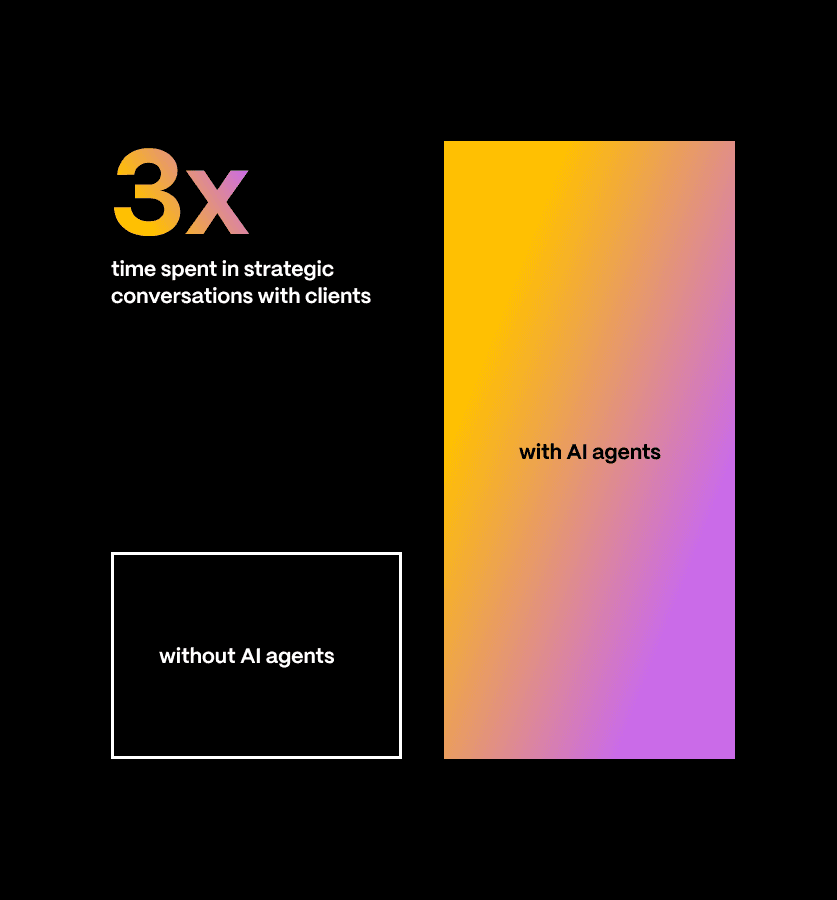
Early movers in AI agent adoption for relationship amplification are building advantages that competitors can't easily replicate. Your competitors who figure this out will spend 3-4x more time in strategic conversations, develop 2-3x deeper client understanding, and become the trusted partner instead of one of many vendors.
The gap between these two won't narrow. It will widen.
Why This Matters
The development team we worked with had the right intentions but no capacity. They knew product releases needed clear, consistent stakeholder communication, but between sprint cycles and technical priorities, it never happened well.
Updates were rushed, incomplete, or simply forgotten. Stakeholders felt blindsided by changes; adoption lagged, and organizational support was tepid at best. We built an agent that owned the entire release communication process: drafting updates, generating documentation, and coordinating messaging.
The transformation was immediate: stakeholders became advocates, adoption rates jumped, and the team finally had the organizational backing they needed to build great products.
The question isn't whether AI agents will change your business. It's whether you'll use them to amplify what makes you irreplaceable: your ability to build trust, read nuance, and create partnerships that both parties genuinely value.
The relationship era is here. The companies that understand this, that build their AI agent strategy around human connection rather than human replacement, those are the ones that will thrive.
The only question is: Are you ready?
Ready to transform task time into relationship capacity? Let's talk about where AI agents can create the most leverage in your organization. The conversation starts with understanding where your team's brilliance is currently buried in busy work—and how to set it free.
Curious where AI could create the most impact for your team? Start the conversation at hellorevel@infogain.com.

Steven Driggs
Copilot & AI Solution Architect